Trucking Compliance Blog
Discover trucking compliance blogs on DOT regulations, ELD compliance, fleet safety, driver qualification, safety training, audits, and transportation best practices.
HomeBlog
Discover trucking compliance blogs on DOT regulations, ELD compliance, fleet safety, driver qualification, safety training, audits, and transportation best practices.
A driver picks up a speeding ticket, 21 kilometers per hour over. He pays it, because fighting it means a day off the road and the fine is only a few hundred dollars. Nobody thinks about it again.
That ticket is worth five CVOR points, one of the highest values a single conviction can carry. For a small fleet, one conviction like that can move the violation rate several percentage points closer to a warning letter. The fine was never the real cost.
Most carriers know their CVOR matters. Far fewer know how the arithmetic behind it works, which is why decisions like that one get made every day. This guide explains what your CVOR actually measures, the real numbers behind each stage of Ministry intervention, and what you can control.
What your CVOR record tracks
Your Commercial Vehicle Operator's Registration is your safety record with Ontario's Ministry of Transportation, and it follows your fleet everywhere you do business. The Ministry records four kinds of events
The first three
generate points. Those points drive your violation rate, and your violation
rate determines your safety rating. That rating is public, which is why this
reaches well beyond paperwork.
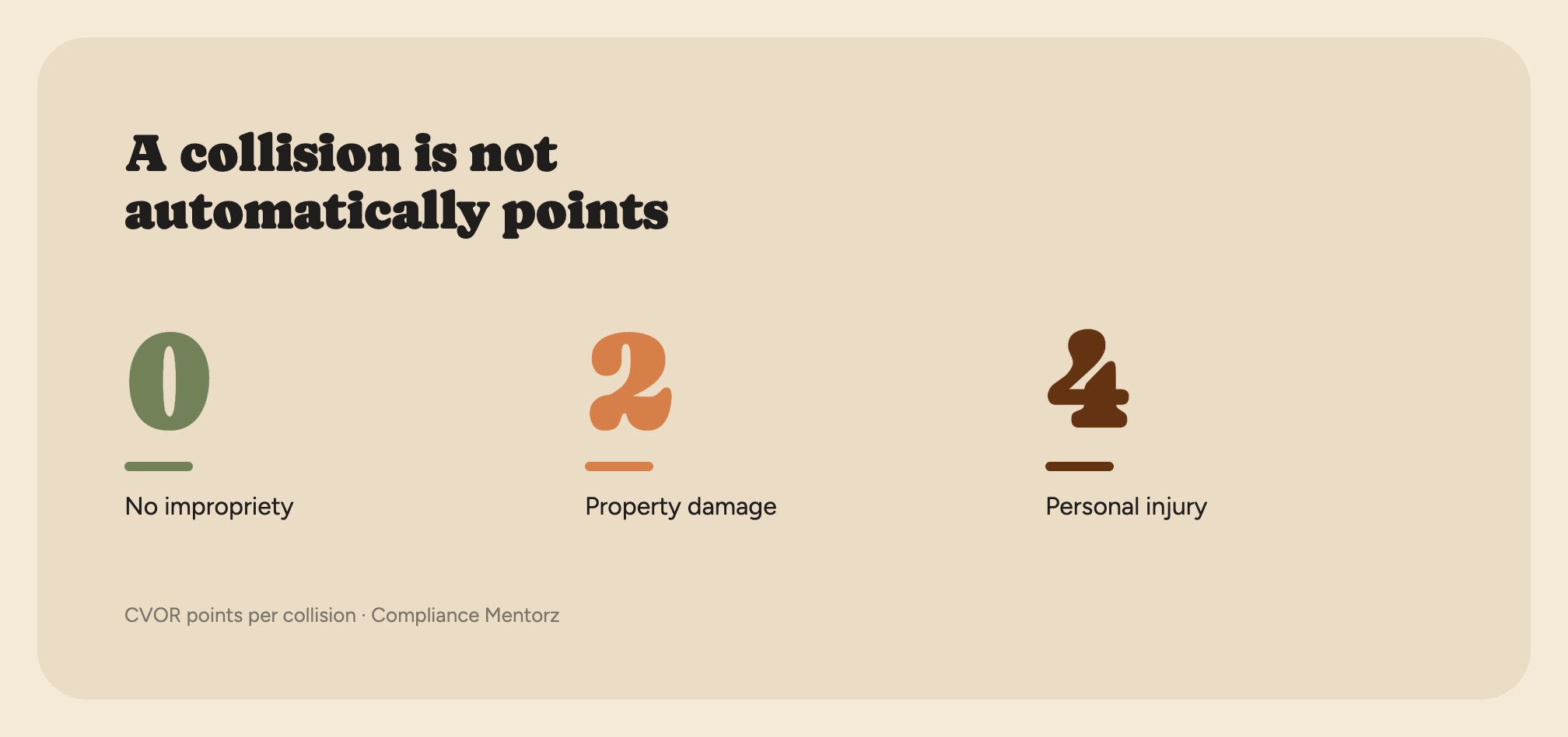
This is where carriers are most often surprised, because a collision on your record does not automatically mean points on your record.
The Ministry weighs two things: whether an impropriety was noted, and how severe the collision was. If police found no impropriety on your driver's part and no vehicle defect, the collision appears on your abstract but carries zero points. Where an impropriety was noted, a property damage collision carries 2 points and a collision involving personal injury carries 4 points.
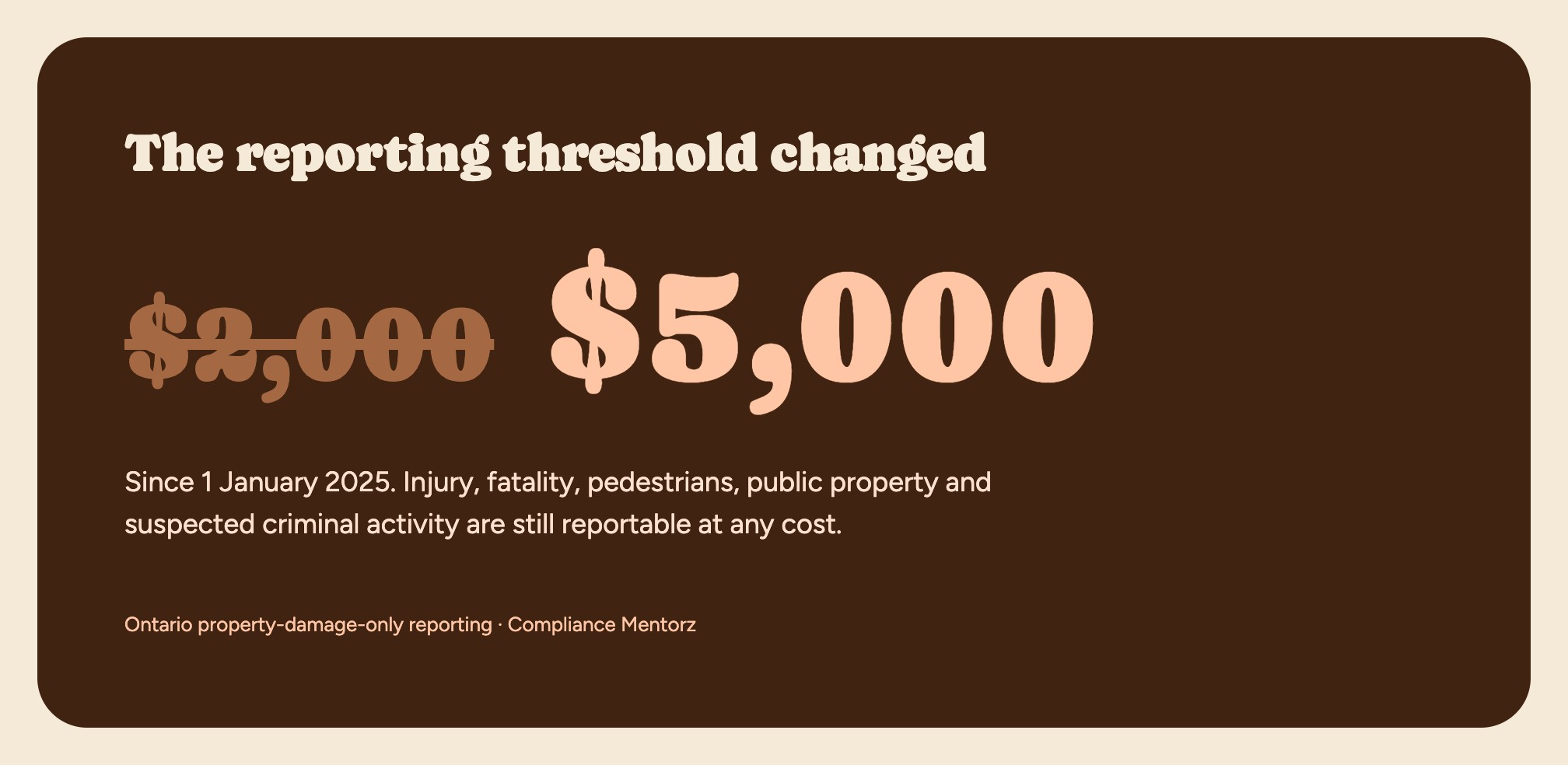
One important update many carriers have missed: as of 1 January 2025, Ontario raised the property damage reporting threshold from $2,000 to $5,000. Property damage only collisions now require a police report only when total damage across all vehicles and property reaches $5,000. Collisions involving injury, fatality, pedestrians or cyclists, public property, or suspected criminal activity must still be reported regardless of cost. Plenty of industry articles still quote the old $2,000 figure, so it is worth knowing which number is current.
Convictions
When a driver or the company is convicted of an offence, points are added according to the Ministry's conviction code table. Most Highway Traffic Act offences fall in the zero to five point range, weighted by how safety related they are. Purely administrative offences can appear at zero points. Driving related Criminal Code convictions sit at the top of the scale and carry considerably more.
Convictions from other
Canadian provinces are shared with Ontario through national data exchange and
appear on your record, so a clean run at home is not the whole picture.
Inspections
Roadside inspections
generate points for out of service defects. The more serious or numerous the
defects found on a unit, the higher the points. This is the category most
directly under your control on any given morning, which is why a genuine pre
trip inspection is the cheapest protection available to a carrier.
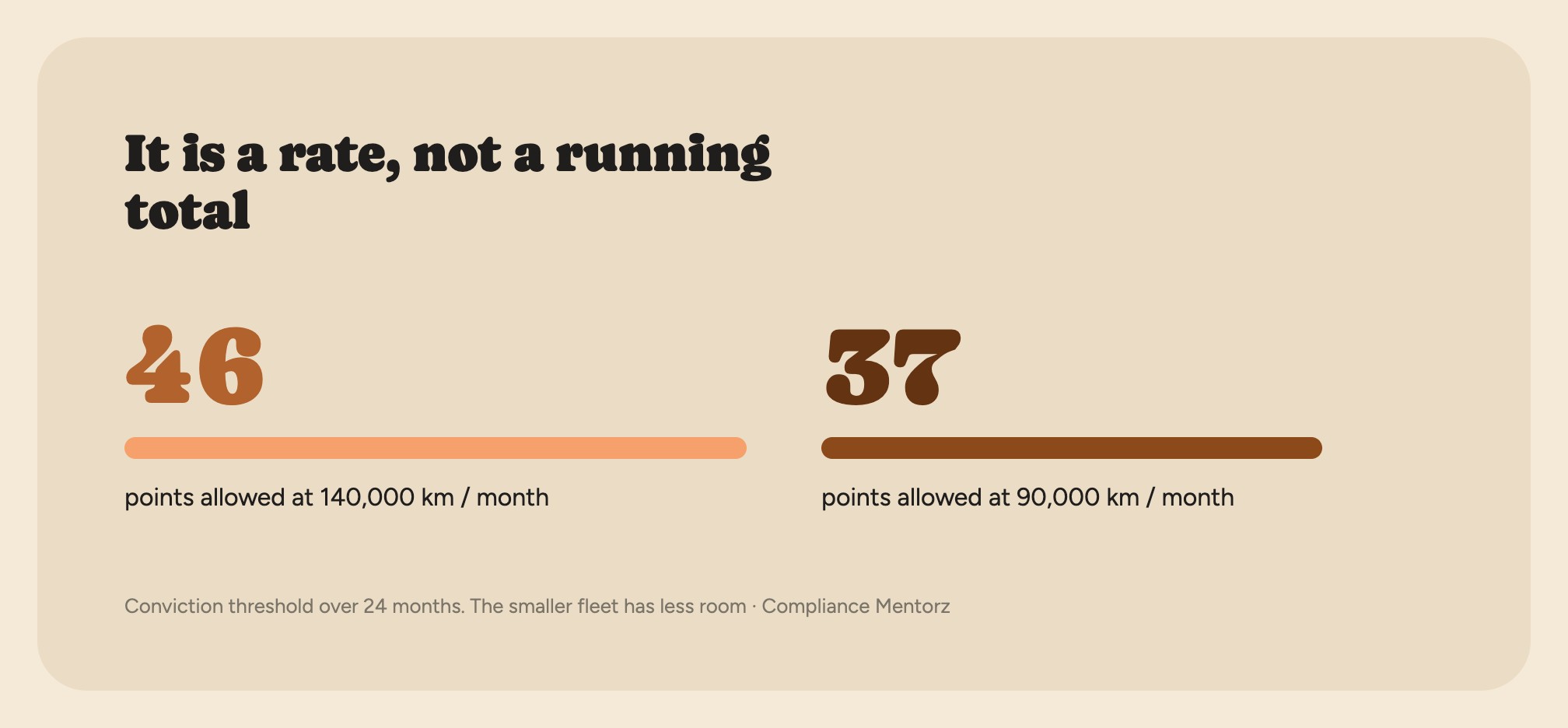
Here is the misunderstanding that causes the most damage: your CVOR is not a running total of points that eventually hits a limit. It is a rate, measured against a threshold calculated specifically for your fleet.
For collisions and convictions, your threshold is based on the kilometres your fleet travels in Canada. For inspections, it is based on the number of units, drivers and vehicles, that were inspected. Everything is measured over a rolling 24 month window.
The practical effect
is that identical events land very differently depending on the size of your
operation. A fleet running 140,000 kilometres a month is allowed roughly 46
conviction points across 24 months before hitting its threshold. A fleet
running 90,000 kilometres a month is allowed roughly 37. The smaller operation
has less room, so the same two tickets consume a bigger share of what it is
permitted. Large fleets are not punished for having more trucks, and small
fleets do not get a free pass for having fewer.
The formula, in plain arithmetic
Each of the three categories produces its own rate, expressed as a percentage of that category's threshold. Those three percentages are then combined, with collisions and convictions counting double the weight of inspections, in a 2:2:1 ratio.
The calculation is straightforward:
(2 × collision rate) + (2 × conviction rate) + (inspection rate), all divided by 5
You divide by five because that is the sum of the weights, 2 plus 2 plus 1.
A worked example from the Ministry's own guidelines makes it concrete. Take a carrier with a collision rate at 32.19 percent of threshold, a conviction rate at 19.96 percent, and an inspection rate at 66.71 percent:
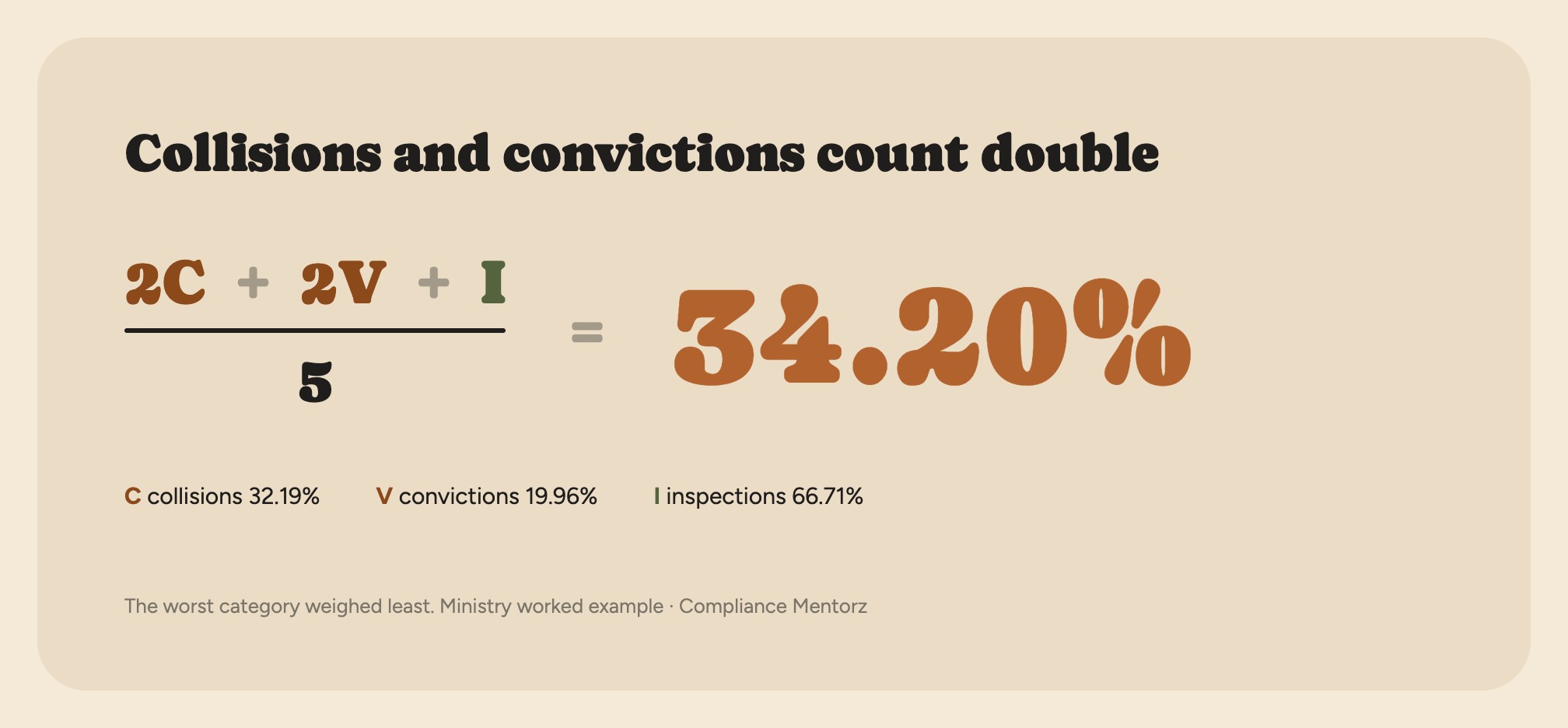
Notice what happened there. That carrier's inspection performance was poor, two thirds of the way to its threshold, but because inspections carry the lightest weight, the overall rate landed at 34 percent. Had those same numbers appeared in the collision or conviction categories, the overall rate would have been far worse. Collisions and convictions are where the real damage is done.What your rate actually triggers
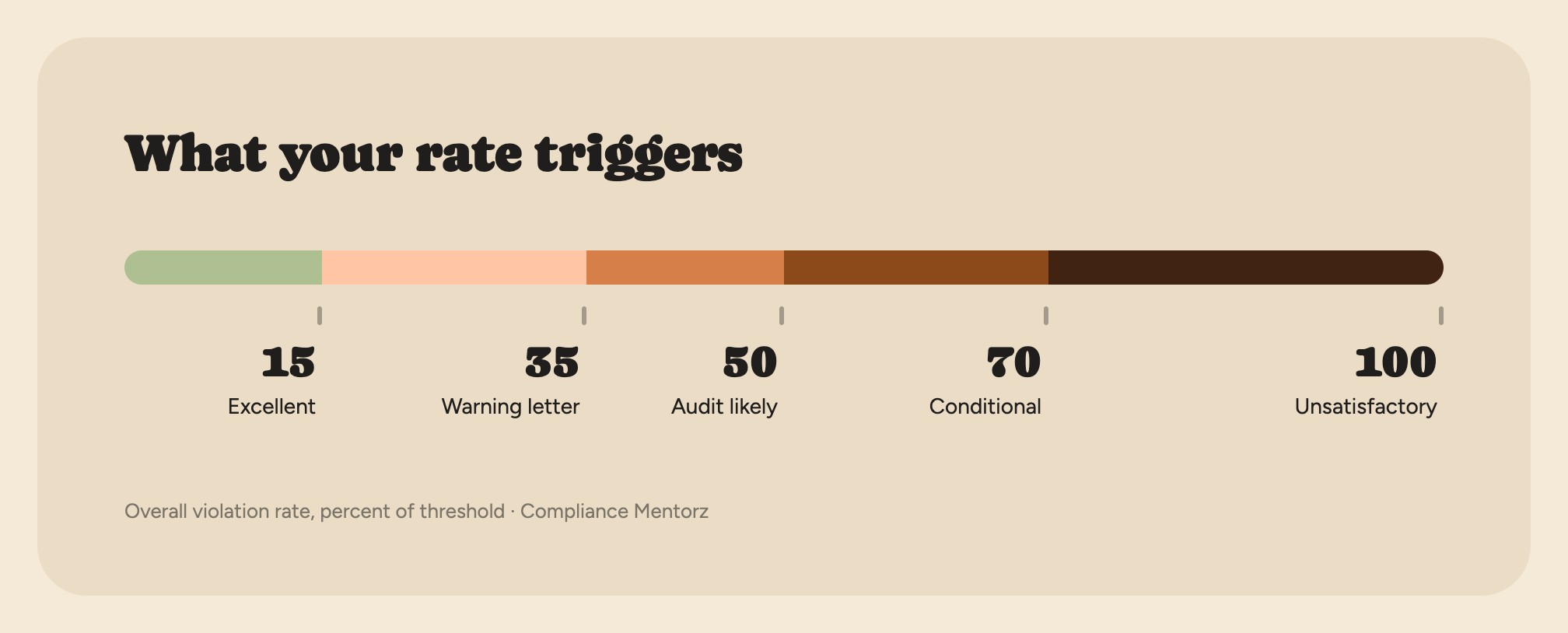
This is the section worth pinning to the wall. Your overall violation rate, expressed as a percentage of your threshold, drives what the Ministry does next:
| Overall violation rate | What it means |
| 15% or less | Meets the standard for an Excellent rating |
| 20% or less | Required to keep an Excellent rating once earned |
| Around 35% | A warning letter typically arrives |
| Around 50% | A facility audit becomes likely |
| Up to 70% | Satisfactory range |
| Above 70% | Rating at risk of dropping to Conditional |
| Above 100% | Unsatisfactory, with operating privileges at risk |
Earning an Excellent rating takes more than a low rate. It generally requires at least 24 months of demonstrated operation in Ontario with a valid CVOR certificate, an overall violation rate of 15 percent or less, a collision violation rate of 10 percent or less, and a strong facility audit result. Keeping it allows slightly more room, 20 percent overall and 15 percent on collisions.
Because these figures
are set by the Ministry and can be revised, confirm the current numbers before
making a decision that depends on them. The structure, though, is stable: lower
is better, and the climb happens quietly until an intervention lands in the
mail.
The timing that catches people out
Two clocks run at the same time.
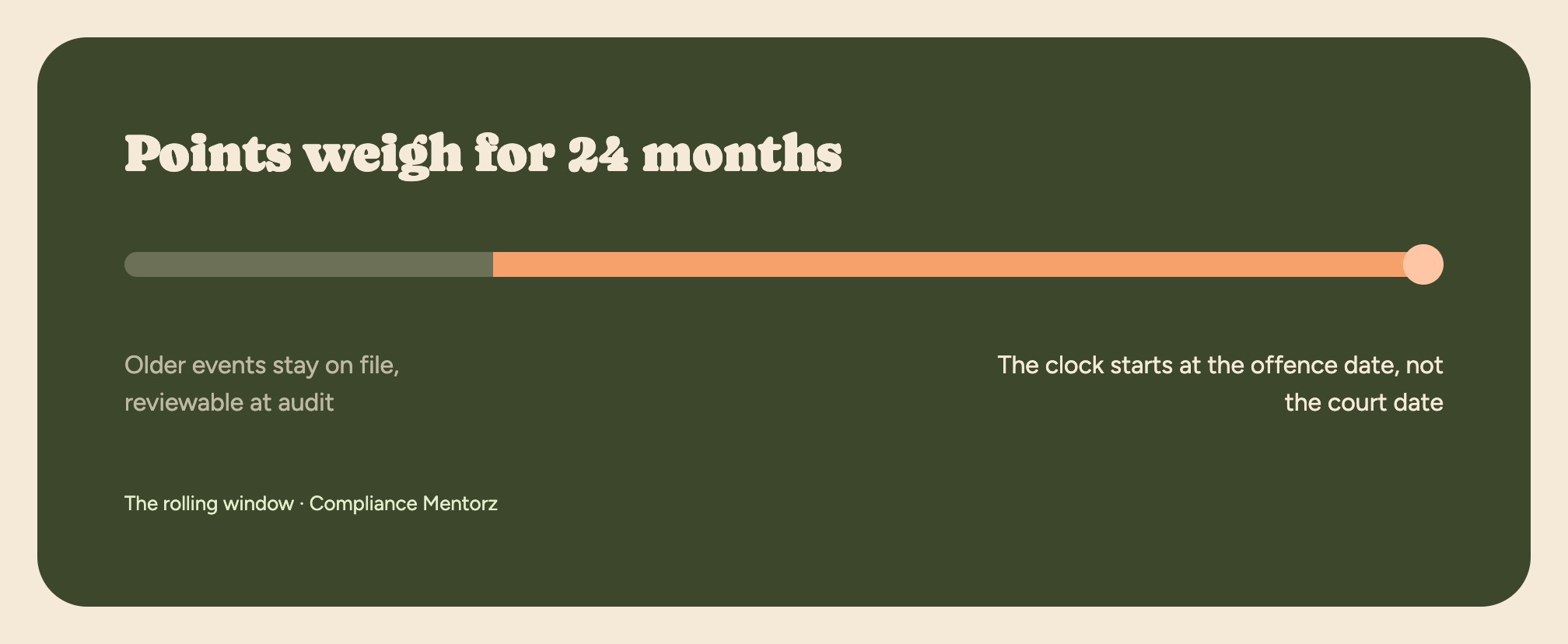
Points count toward your violation rate for 24 months, on a sliding window. Once an event passes that mark, it stops affecting your rate, even though the event itself remains in the Ministry's records and can be reviewed during a facility audit.
For convictions, the
clock is tied to the offence, not the court date. That has a real consequence:
a charge that takes many months to work through the courts spends fewer of its
active months actually weighing on your rate. It is one reason that reflexively
paying a ticket is rarely the cheapest option. Whether to contest a charge is a
legal question and worth proper advice, but the principle holds. Every
conviction avoided is points that never enter the window at all.
Why the rating is worth defending
Your safety rating is public, and the people who matter check it.
Insurers price your
premiums against it at renewal. Shippers check it before awarding freight, and
many simply will not hire a carrier with a poor record. A clean rating is a
competitive advantage you can point to. A weak one costs you money and contracts
long before it ever threatens your ability to operate.
Almost everything driving your rate is within your control. Carriers who stay clean tend to do the same handful of things well.
Where Compliance Mentorz fits in
Protecting a CVOR rating is steady, detailed work that touches nearly every part of an operation. Compliance Mentorz helps carriers monitor their record, build the driver, maintenance, and training programs that keep the rate down, investigate collisions properly, and prepare for audits before they arrive.
If your rating is
slipping, or you want to keep a clean record clean, contact us or call (905)
486-1666. We will review where you stand and give you a straight answer.

Privacy Policy Compliance Mentorz SMS Consent © 2026 Compliance Mentorz. All Rights Reserved.