Trucking Compliance Blog
Discover trucking compliance blogs on DOT regulations, ELD compliance, fleet safety, driver qualification, safety training, audits, and transportation best practices.
HomeBlog
Discover trucking compliance blogs on DOT regulations, ELD compliance, fleet safety, driver qualification, safety training, audits, and transportation best practices.
If one of your drivers cannot answer an American inspector's questions in English, that driver is placed out of service at the roadside. Not fined. Not warned. Stopped, where the truck is standing, with your load on it.
This has been the enforcement position since 25 June 2025, and the rule behind it is older than any carrier reading this page. What changed is the consequence, and a great deal of what is being said about it in our industry right now is wrong.
The requirement sits in 49 CFR 391.11(b)(2). A driver must be able to read and speak English well enough to converse with the general public, understand highway traffic signs and signals, respond to official inquiries, and make entries on reports and records.
Drivers based in Canada and Mexico have been subject to it for decades. In the Federal Register notice published on 10 August 2026, the Federal Motor Carrier Safety Administration states that Canada and Mexico domiciled drivers "have been subject to the ELP rules since they were implemented in the 1930s", and that the agency has had English language proficiency requirements dating back to 1936.
So this is not a new obligation arriving from Washington. It is an old obligation that has acquired teeth.
On 25 June 2025, non-compliance with 49 CFR 391.11(b)(2) took effect as a driver out-of-service violation under the North American Standard Out-of-Service Criteria. The Commercial Vehicle Safety Alliance, which publishes those criteria, confirmed it would appear in the printed edition from 1 April 2026.
An out-of-service order is a different animal from a citation. A citation is money and a mark on a record. An out-of-service order means the driver cannot operate the vehicle until the condition is corrected, and in this case the condition is not a loose brake adjuster that a mobile mechanic can fix in the yard.
FMCSA published its own enforcement data in the August 2026 notice. The clearest way to read it is not the raw counts, because the two periods are different lengths. It is the share of violations that ended with the truck stopped.
Between January 2025 and 24 June 2025, inspectors issued 7,812 English language proficiency violations across the United States. Thirty-three of them resulted in an out-of-service order, which is 0.4 percent.
Between 25 June 2025 and 19 March 2026, inspectors issued 60,399 violations. Of those, 19,045 resulted in an out-of-service order, which is 31.5 percent.
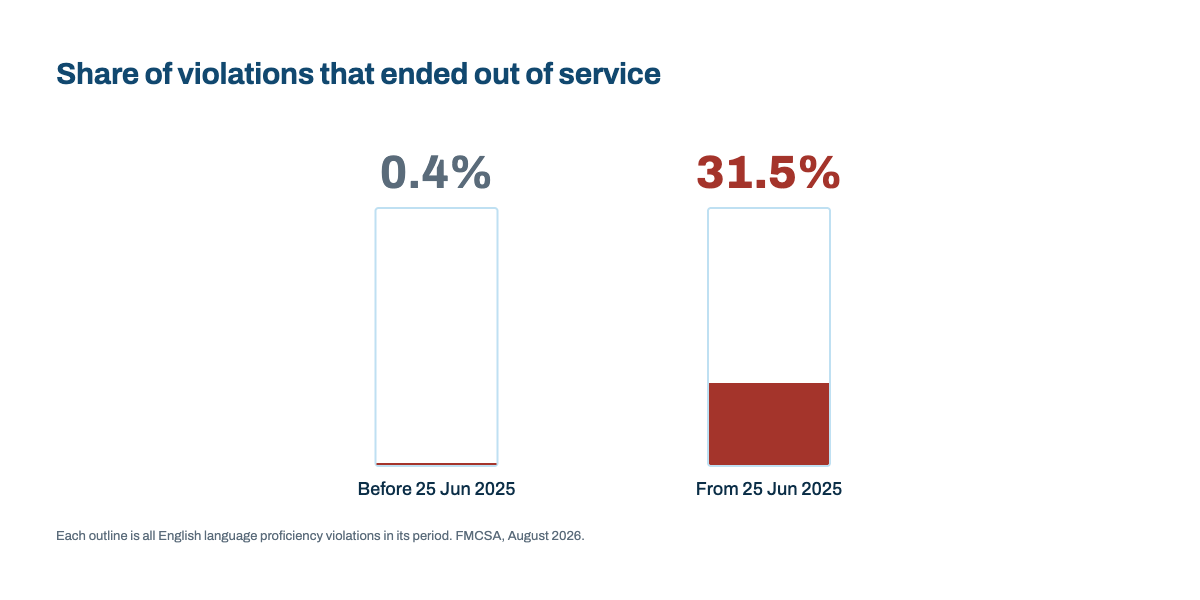
Before the change a violation almost never stopped the truck. After it, close to one in three did. The requirement did not change. The consequence did.
FMCSA also states that all 19,045 of those out-of-service orders occurred outside the border commercial zones. For a carrier running south from Canada, that is the most important sentence in the document, and the next section explains why.
The current roadside policy is FMCSA enforcement memo MC-SEE-2026-0002, revised 16 April 2026 and effective immediately. It rescinded and replaced the earlier May 2025 memo, which matters because a good deal of the commentary still circulating describes the old one.
The assessment has two steps.
Step one is a driver interview. The inspector tells the driver to respond in English, then asks the official questions an inspection normally involves. The memo is specific about what cannot be used during this step: interpreters, I-Speak cards, cue cards, smartphone applications, and the On-Call Telephone Interpretation Service.
If the driver cannot respond sufficiently in English, the inspector cites a violation of 49 CFR 391.11(b)(2) and does not go on to step two. Failing step one is enough on its own. There is no second chance at the signs.
Step two is a highway traffic sign recognition assessment. The driver has to demonstrate an understanding of American highway traffic signs in English. It covers signs conforming to the Manual on Uniform Traffic Control Devices, and it covers electronic changeable message signs, the overhead boards that carry live instructions. The specific sign examples the memo uses are redacted in the public version, so no published study list exists.
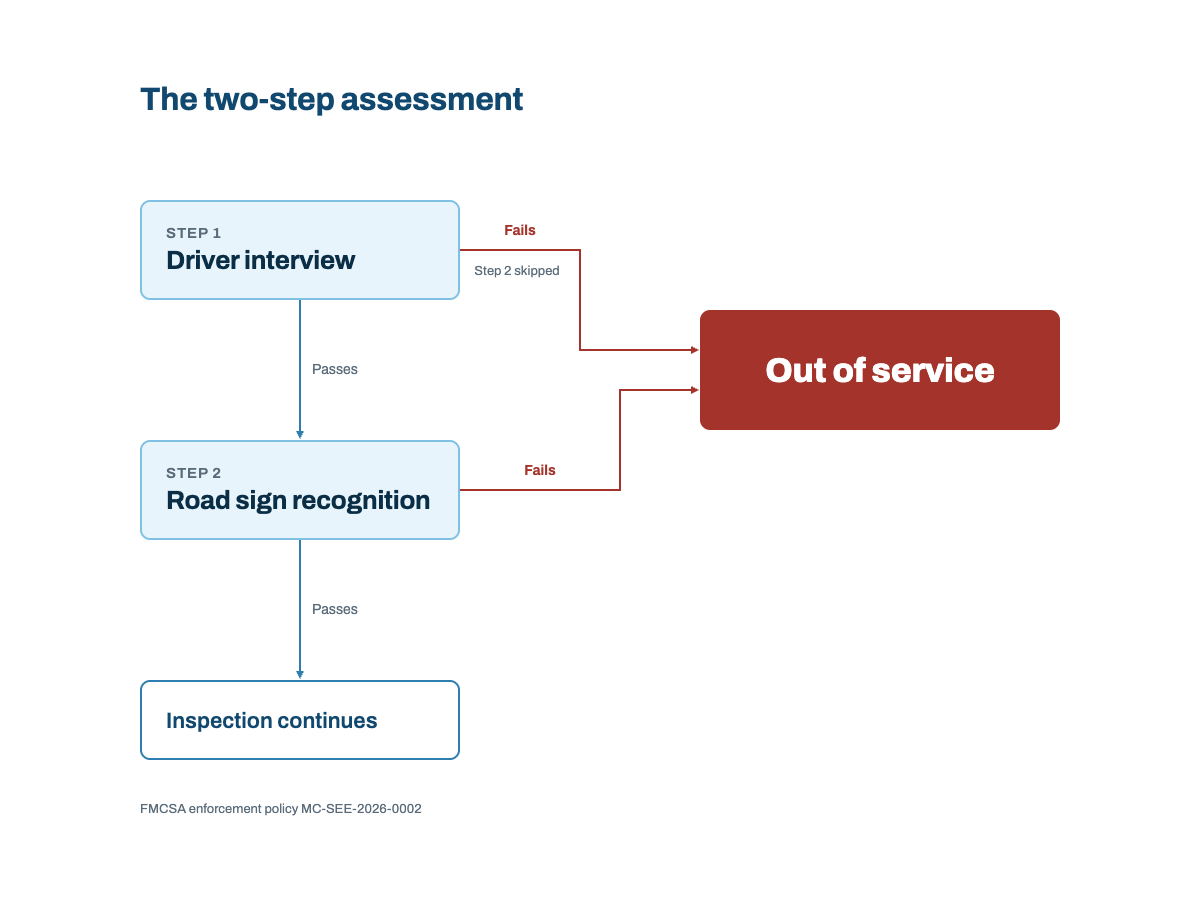
The consequence follows the citation, at either step. Where the inspector cites the driver, the memo requires the inspector to document the evidence and directs that the driver be placed out of service immediately, unless the narrow exception described below applies.
This is the part Canadian carriers most need to understand, and the part most often reported incorrectly.
The memo does contain an exception, and it is narrow. If a driver's current trip stays inside the United States and Mexico border commercial zones, a failed assessment results in a citation without an out-of-service order. The memo's worked example is a shipment from Nuevo Laredo to a warehouse within the Laredo, Texas zone.
That exception applies to the United States and Mexico border commercial zones, and those zones are a defined regulatory term: the zones designated in 49 CFR part 372, subpart B, along the United States and Mexico international border. There is no equivalent zone on the Canadian border. A driver stopped in Michigan, New York or Washington State gets the full consequence, whether the trip is three hundred miles or thirty.
FMCSA's current roadside enforcement FAQ, issued 6 October 2026, puts this beyond argument. The enforcement policy "applies to all drivers operating a CMV in interstate commerce in the United States", and the exception turns on the scope of the driver's trip "irrespective of the driver or motor carrier's country of domicile or whether the driver holds a U.S. CDL, Mexican Licencia Federal de Conductor, or Canadian CDL".
Read that carefully, because it cuts both ways. Holding a Canadian licence exposes your driver to nothing extra, and exempts them from nothing either. The policy is blind to nationality. What decides the out-of-service order is where the trip goes, and a trip out of Canada goes nowhere near a United States and Mexico border commercial zone.
One further exception exists and is unrelated to geography. A driver operating under a hearing standard exemption granted under 49 CFR 391.41(b)(11) is not placed out of service under 391.11(b)(2) for being unable to communicate orally in English.
The immediate cost is operational and it is obvious once you have lived through it. The truck stops where it is. Somebody has to get a qualified driver to that location, or recover the unit and the trailer. The load is late at best. If it is temperature controlled or time critical, late is the optimistic version.
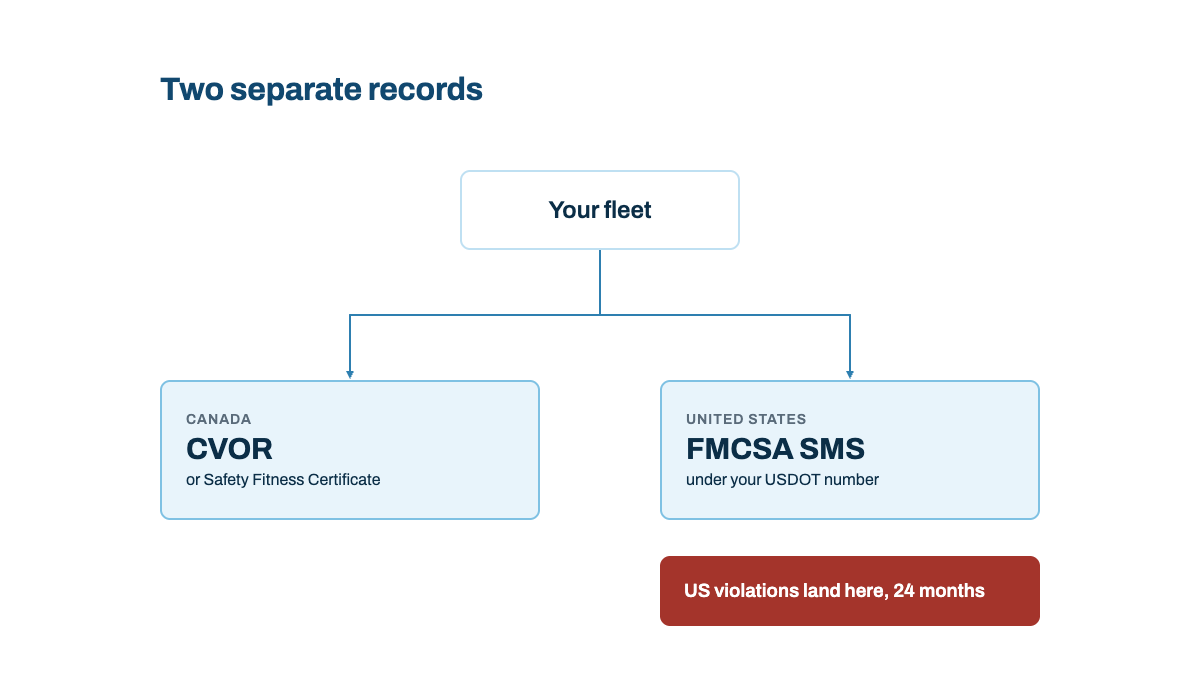
The second cost is slower and lasts longer. You carry two safety records, and most Canadian carriers think hard about one of them and barely about the other.
Your home record is the one you know. In Ontario it is your CVOR, with its violation rate and threshold. In Alberta and British Columbia it is the carrier profile attached to your Safety Fitness Certificate.
Your second record sits under your USDOT number, in the Federal Motor Carrier Safety Administration's Safety Measurement System. Driver qualification violations fall in the Driver Fitness BASIC, which is tied to 49 CFR Parts 383 and 391. Data stays in the system for twenty-four months, and the percentile improves with time and with clean inspections rather than with explanation.
That record is what American enforcement uses to decide whether to look at you more closely, and it is visible to the brokers and shippers who check before they tender freight.
A second American rule has caused real confusion in our market this year, and it is worth separating from the first.
On 16 March 2026 a final rule took effect restricting who may hold a United States non-domiciled commercial learner's permit or commercial driver's licence. It reaffirmed an interim final rule from 29 September 2025. Eligibility is now limited to people in H-2A, H-2B and E-2 nonimmigrant status. The rule excludes a long list of other categories, including holders of employment authorization documents generally, DACA recipients, refugees, asylees, humanitarian parolees and people in TPS, L-1, H-1B, TN and O-1 status.
Here is the part that matters to you, and the mechanism is worth getting right because it is widely reported wrongly. The restriction does not operate on citizenship. It operates on the licence your driver already holds.
The Administrator has determined that commercial licences issued under the Canadian National Safety Code meet American testing standards. Under 49 CFR 383.23, read with the one licence rule in 49 CFR 383.21, a driver holding a CDL issued under the Canadian National Safety Code is prohibited from obtaining a non-domiciled CDL, or any other state driver's licence. Your drivers are not eligible for the credential this rule restricts, and they have no use for it. They run south on their provincial licence.
The rule itself states that it relates only to obtaining, renewing and upgrading the credential.
So if you have been told that the non-domiciled rule disqualifies your drivers from running south, that is not what it does. It governs who may obtain an American non-domiciled credential. It is the English language requirement, not the licensing rule, that reaches your drivers at the roadside.
One caveat worth knowing. The non-domiciled rule is being challenged in the United States Court of Appeals for the District of Columbia Circuit. That litigation changes nothing above for a driver on a provincial licence, but if you employ anyone in the United States on a non-domiciled credential, follow it.
On 10 August 2026 FMCSA published a notice of proposed rulemaking under docket FMCSA-2026-0826. It would write the out-of-service consequence into the regulations themselves, adding a new 49 CFR 391.11(c) requiring immediate out-of-service placement and amending the definition of an out-of-service order in Part 390. The comment period closed on 9 October 2026.
Two things are worth noting. FMCSA says the proposal does not create new requirements or obligations for regulated entities, because under current enforcement tolerances the violation already carries an out-of-service consequence. And the proposed border zone exemption is again the United States and Mexico zones only.
The practical effect for you is that nothing you need to do is waiting on this rule. The enforcement is already live.
Treat communication ability as a driver qualification matter, not an informal judgment. It belongs in your hiring process and your driver qualification file, assessed the same way for every candidate, with a record of how it was assessed. An undocumented hunch about who will struggle is both unreliable and a liability.
Take advice before you build a screen. This is the point we most often have to raise with carriers. In Canada, a language requirement applied to hiring has to be a genuine requirement of the job, applied consistently, and defensible if challenged. Solving a United States enforcement problem by creating a human rights problem at home is not a trade worth making. Speak to an employment lawyer or a qualified HR adviser about how you word and apply it.
Offer training where there is a gap, and keep the records. A driver who needs support with road signs and official questions can be trained. A documented training program is worth considerably more than an assurance, both to an auditor and to an insurer.
Brief your dispatch and your drivers on the procedure. A driver who knows an inspector will ask them to answer without a phone app behaves differently from a driver who reaches for one. Knowing the two steps is not coaching. It is the same preparation you would do for any inspection.
Have a plan for the call you do not want. Decide now who you reach, how you recover a unit from a state you do not run often, and who notifies the customer. The carriers who handle an out-of-service order badly are almost always the ones improvising it at two in the morning.
Review your wider cross-border file while you are in there. Carriers who are exposed on driver qualification are frequently exposed on the rest of it too: United States operating authority, the drug and alcohol testing program under FMCSA rules, and Clearinghouse queries.
Does this apply to my drivers if they only cross occasionally? Yes. The requirement attaches to operating a commercial motor vehicle in interstate commerce in the United States, not to how often you do it.
Is there a published list of signs my drivers should learn? Not an official one. The sign examples in the current enforcement memo are redacted in the public version, so treat anyone selling you the official list with suspicion. Training on standard American highway signs is still worthwhile, but a definitive answer key is not publicly available.
Can my driver use a translation app during the inspection? No. The memo names smartphone applications, interpreters, cue cards, I-Speak cards and the On-Call Telephone Interpretation Service as tools that should not be used during the driver interview.
Does a failed assessment affect my CVOR? Your Ontario record and your United States record are separate systems. A United States roadside violation lands on your record under your USDOT number. Whether it also reaches your Ontario violation rate is something we would rather confirm with the Ministry against your specific file than answer loosely on a web page, because carriers make expensive decisions on the answer.
My driver was placed out of service. What now? Recover the unit and the load first, then deal with the record. There is a difference between an inspection result you accept and one you document and challenge, and the window for the second one is short.
We build and maintain driver qualification files, set up and run United States operating authority and drug and alcohol testing programs, and represent carriers through audits on both sides of the border. If you run into the United States and you have never had your cross-border driver file reviewed against what an American inspector or auditor actually asks for, that review is the cheapest thing you will do this year.
Call us on +1 (905) 486-1666 or contact us for a cross-border compliance review.

Privacy Policy Compliance Mentorz SMS Consent © 2026 Compliance Mentorz. All Rights Reserved.